07 / A city is not a bundle of systems. It is a set of choices for its people.
A city is not a bundle of systems. It is a set of choices for its people.
07 / LIVING DOSSIER
A city is not a bundle of systems. It is a set of choices for its people.
Six lenses show how Marius Arc becomes a place to live, work and belong.
01
CITY / URBAN FORM
Neighbourhoods underground
Each residential district is divided into blocks of a few hundred people. Schools, clinics, shared kitchens, gardens and repair workshops sit within walking distance, while larger commercial districts and the spaceport remain connected nearby.
02
LIFE / DAILY CULTURE
Choosing food made on the Moon
Daily meals extend beyond cultivated meat: fermented protein dishes, mushroom sauces, algae noodles, greenhouse leaves and fresh bread. Hygienic small packs and reusable trays circulate among shops, schools and homes.
03
WORK / LUNAR PROFESSIONS
Work that keeps a city alive
Spaceport controllers, gravity-environment designers, pressure-shell inspectors, ice workers, fermentation cooks, low-gravity coaches, teachers and theatre technicians make lunar life more than a story about astronauts.
04
SHELTER / ARCHITECTURAL PROMISE
People do not live in a cave
Rock is the outer skin that stops radiation and micrometeorites. Inside it, people inhabit repairable pressure shells with finished walls and vaulted ceilings. Separate service spines keep home from becoming a worksite during maintenance.
05
SYSTEMS / URBAN METABOLISM
Recycling is not enough
Water recovery is fundamental, but a growing population also needs new supply. The city combines subsurface ice processing, chemical synthesis, recovery and storage. Solar power, storage and fusion protect systems that must never stop.
06
CONNECTION / EARTH TRANSIT
Distant Earth, nearby Moon
Travel to Earth becomes an option for work, education, family visits and tourism. Yet Marius Arc is home for lunar-born people. Freedom to travel and roots on the Moon are not opposites; together they form a new civic identity.
07 / VISUAL FIELD NOTE
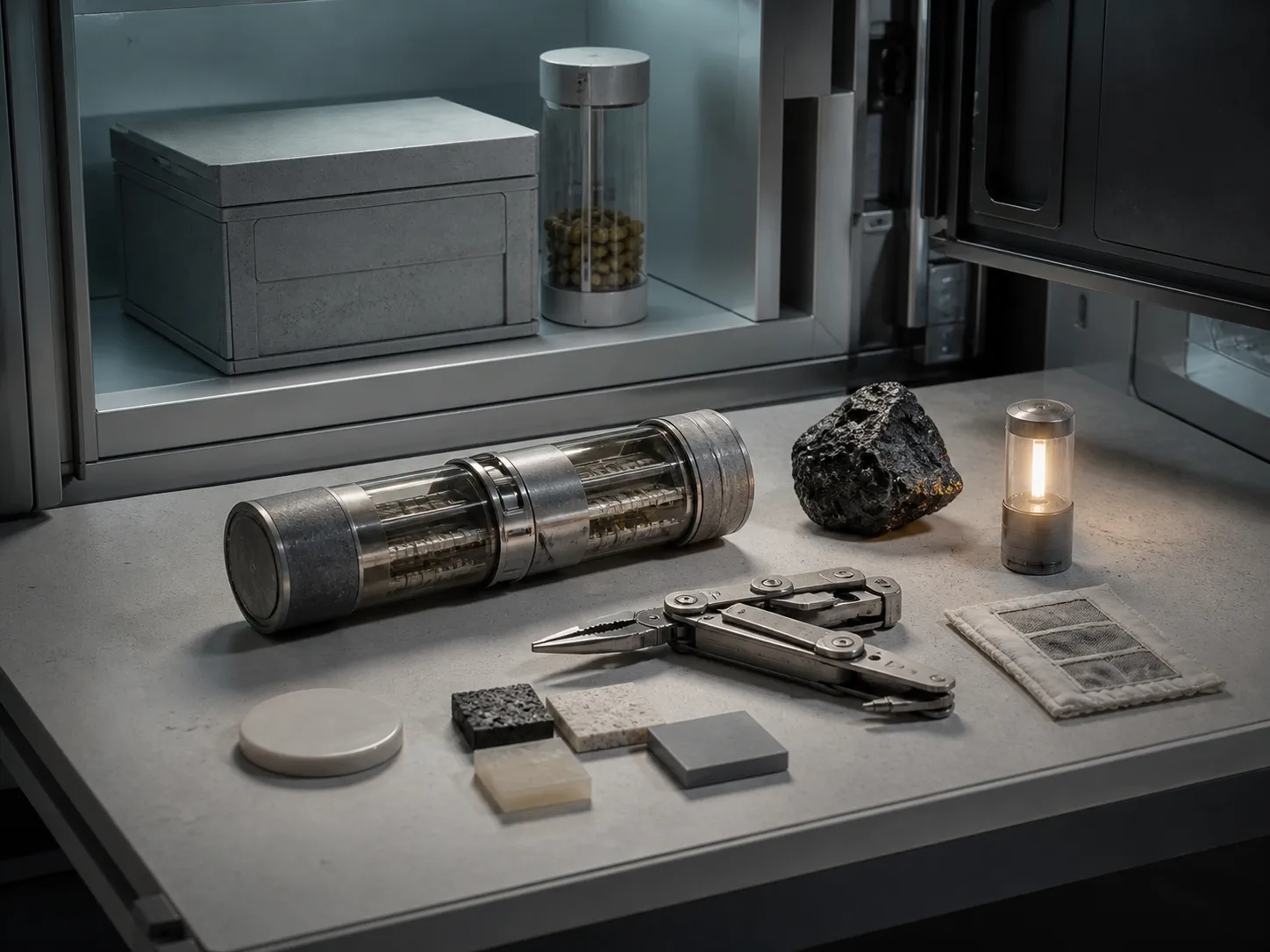
A city's lifetime is recorded not only in machinery, but in objects that are used, repaired and inherited.
LIVING DOSSIER / CIVIC RECORD
Measure the city across an entire lunar life.
A city is not complete because it has enough machinery. People must be able to be born, learn, work, form families, become ill, age and leave memories without being sent back to Earth. That full lifetime is the boundary between a base and a home.
100,000CITY RESIDENTS
19 ARCS18 BELOW + SURFACE GATE
1 LIFETIMEBIRTH TO MEMORY
01
BORN + LEARN
Let lunar-born children treat the Moon as ordinary.
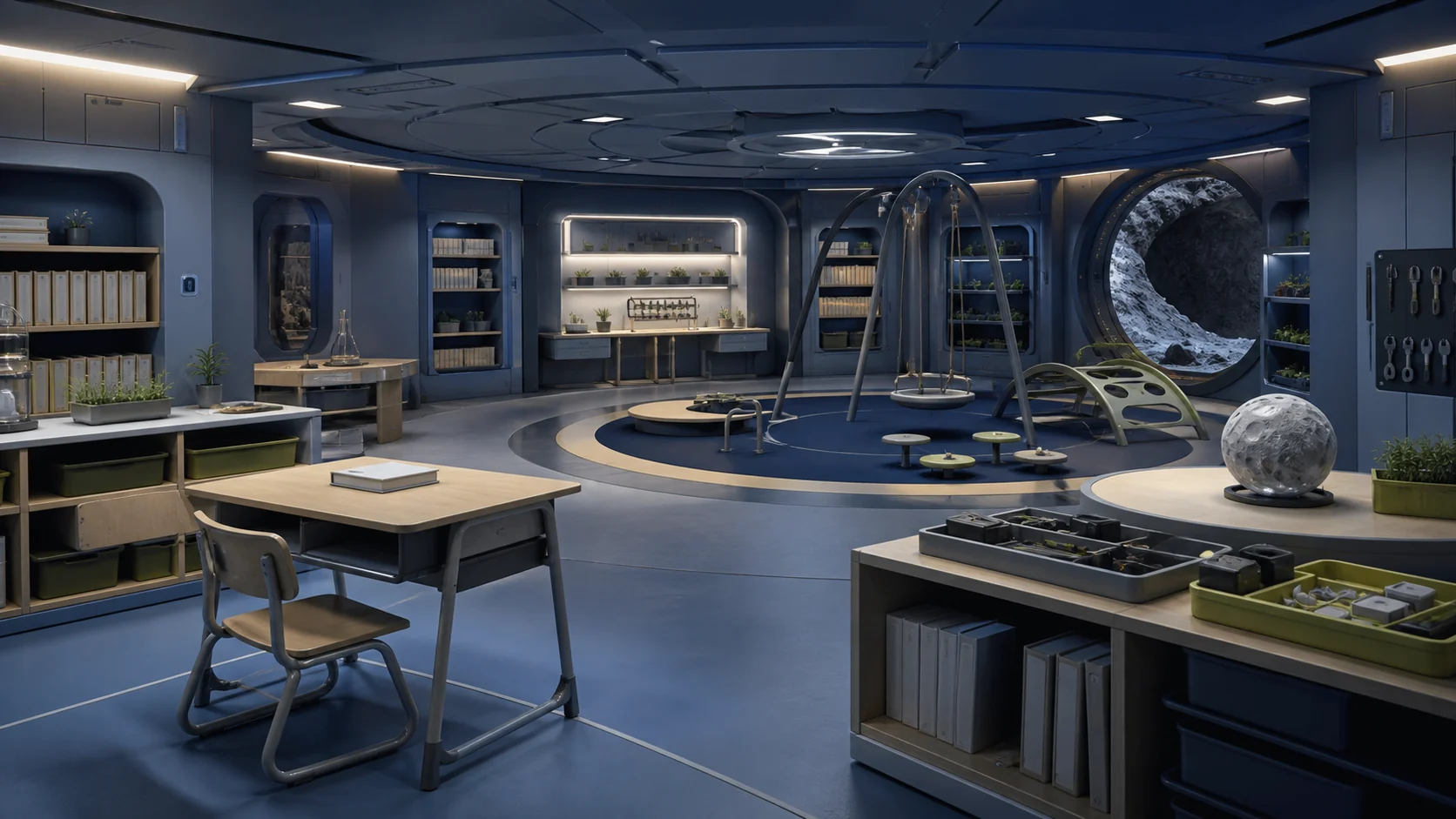
Maternity care, childcare and schools sit close to homes instead of being concentrated in one medical district. Growth in low gravity is observed continuously without turning childhood into constant examination. Running, falling, performing and growing plants remain ordinary school life.
Earth's seas and rain are taught as planetary knowledge; lunar geology, closed environments and resource cycles are local studies. Education supports both the choice to study on Earth and the choice to remain on the Moon.
KEEP CHILDCARE AND SCHOOL WITHIN WALKING DISTANCE
PAIR HEALTH OBSERVATION WITH ORDINARY CHILDHOOD
SUPPORT EDUCATION ON EARTH OR THE MOON
02
WORK + TIME
Keeping the city alive cannot consume every life.
Life support, maintenance, care and transit never stop, but a city of permanent on-call workers cannot endure. Shift work, remote monitoring, automation and mutual aid distribute nights and emergencies across districts.
Outside work there are theatres, sports halls, kitchens, workshops and quiet gardens. Lunar professions extend beyond astronauts to teachers, cooks, carers, editors and shoe repairers. Usefulness and living are not made into the same thing.
DISTRIBUTE ESSENTIAL WORK THROUGH SHIFTS
USE AUTOMATION TO PROTECT HUMAN REST
TREAT CARE, CULTURE AND SHOPS AS CORE INFRASTRUCTURE
VISUAL FIELD NOTE
Keeping the city alive cannot consume every life.
03
CARE + AGE
Treatment should not require leaving home.
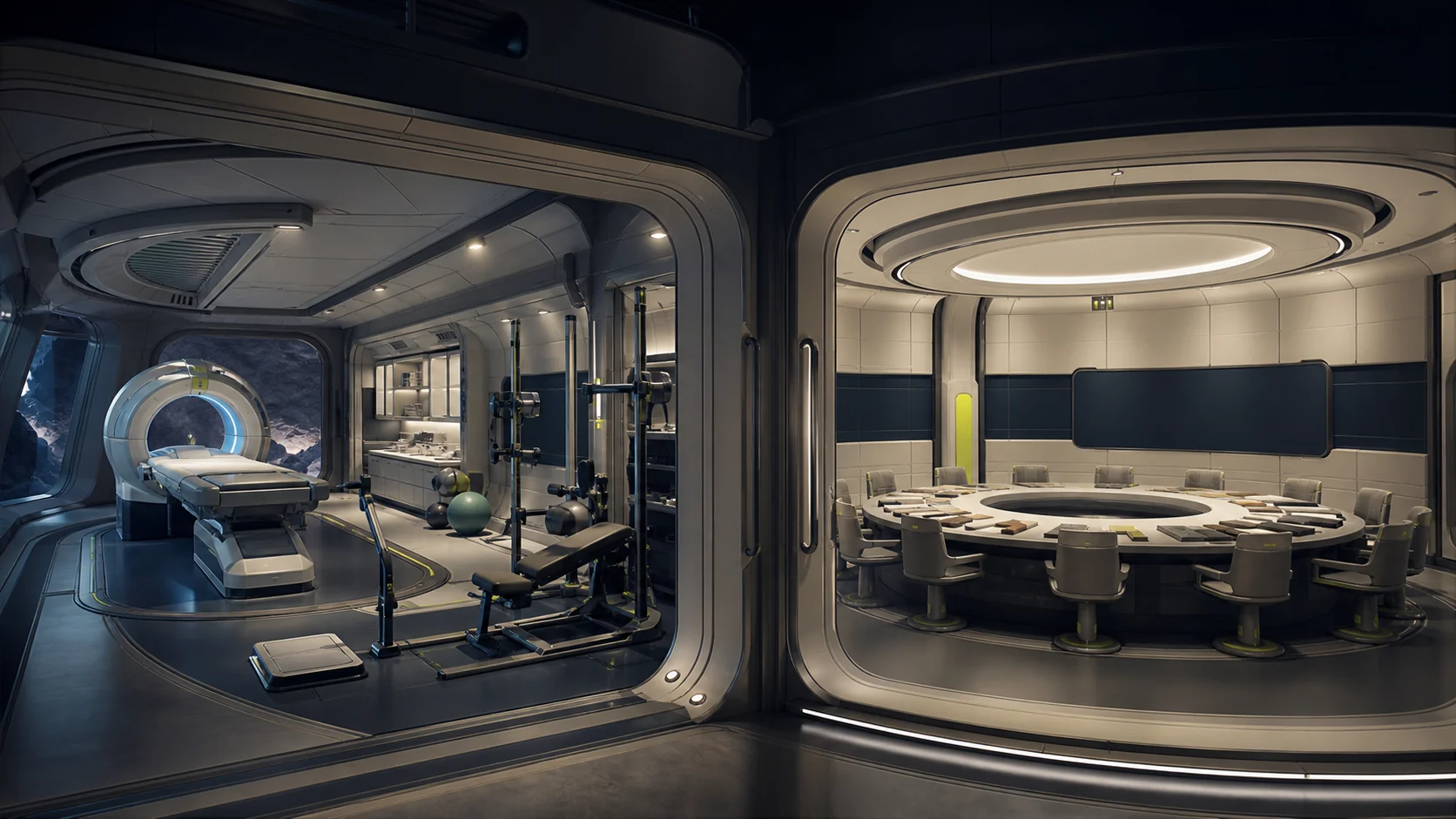
The city expands the care it can complete locally: general medicine, birth, surgery, rehabilitation, mental health and end-of-life care. Earth specialists collaborate through communication links, but lunar teams retain urgent decisions and daily relationships.
Older and recovering residents live in the quiet district, not in a hospital annex. Mobility, low-gravity exercise, meals, family stays and final care form one environment. Public space also includes places to preserve records and remember the dead.
KEEP DAILY AND URGENT CARE UNDER LUNAR AUTHORITY
PLACE RECOVERY HOMES INSIDE A LIVING DISTRICT
INCLUDE FAREWELL AND MEMORY IN PUBLIC SERVICE
04
BELONG + DECIDE
Residents must be able to decide what their city becomes.
Shared air and water do not justify making every private life visible. Safety telemetry is separated from personal health, movement and communication data, with clear records of who can see each stream and why.
District meetings, the city council, children's assemblies and public design reviews decide budgets, expansion, transit, festivals and archives. Marius Arc becomes a city when it is governed and revised by the people who live there, not merely owned as an Earth-operated base.
SEPARATE SAFETY TELEMETRY FROM PERSONAL DATA
MAKE DECISIONS AT DISTRICT AND CITY LEVELS
INCLUDE CHILDREN AND FUTURE GENERATIONS
VISUAL FIELD NOTE
Residents must be able to decide what their city becomes.