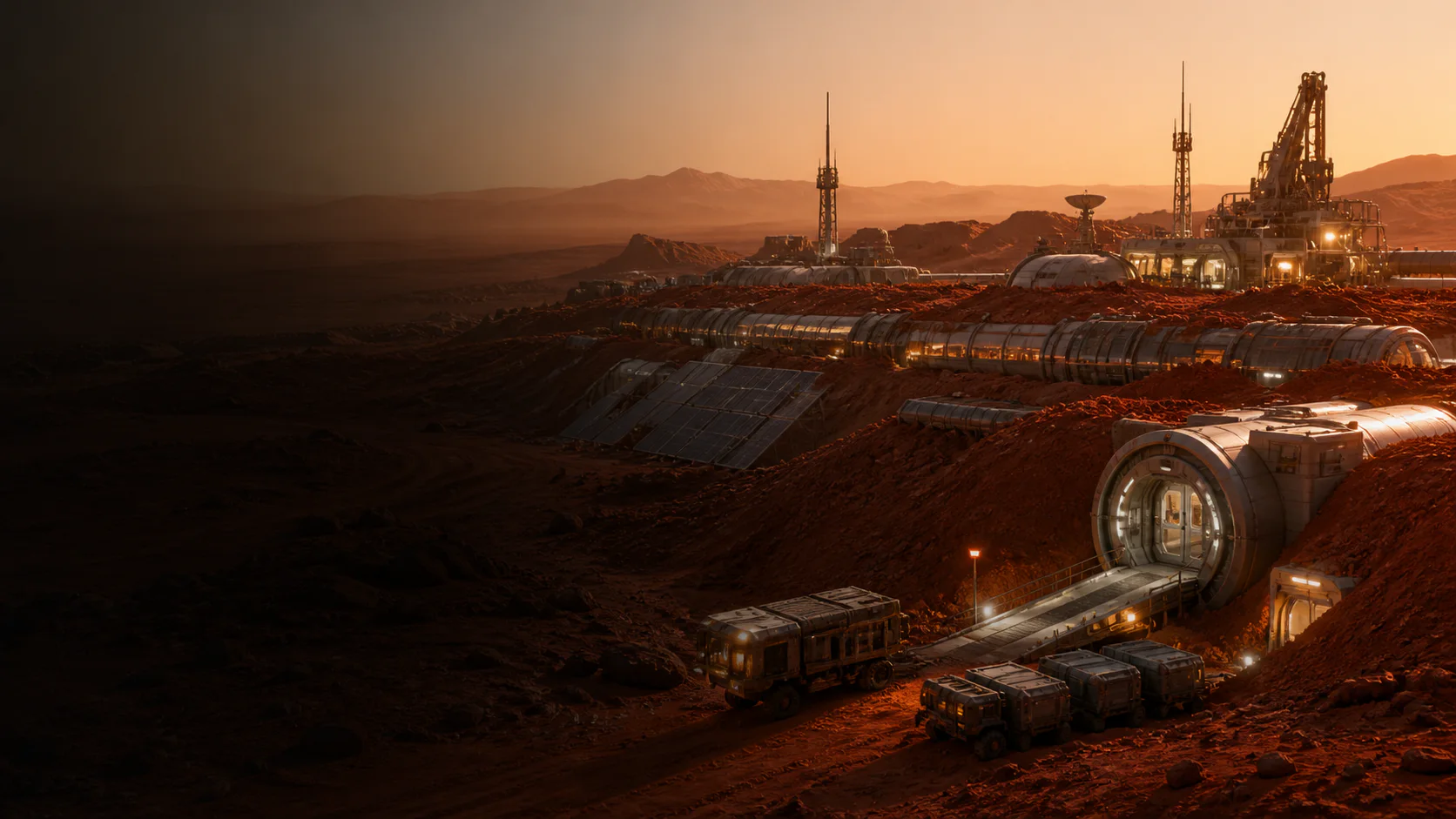
ARCADIA COMMONS / MARS / 2250
Not here to return.
Here to begin life on Mars.
A permanent Martian settlement of 18,600. It is not yet a finished city, but life is no longer organized around an eventual return to Earth.
ENTER LIFE IN 2250 ↓A SETTLEMENT LEARNING TO STAY
FROM THE MOON TO MARS
Technology built a city on the Moon.
Distance built self-rule on Mars.
Pressure architecture, circular utilities and remote construction matured at Marius Arc before crossing to Mars over sixty-four years. Mars is not a copy of the Moon. Cargo moves with planetary geometry, and a conversation with Earth can take tens of minutes to complete.
At Arcadia Commons, the ability to repair a system locally and the authority to decide without waiting for Earth are equally important parts of the settlement.
01 / SETTLEMENT
Not one great dome.
A settlement following buried ice.
Flat landing terrain, shallow subsurface ice and buried districts are joined by pressurized transit.
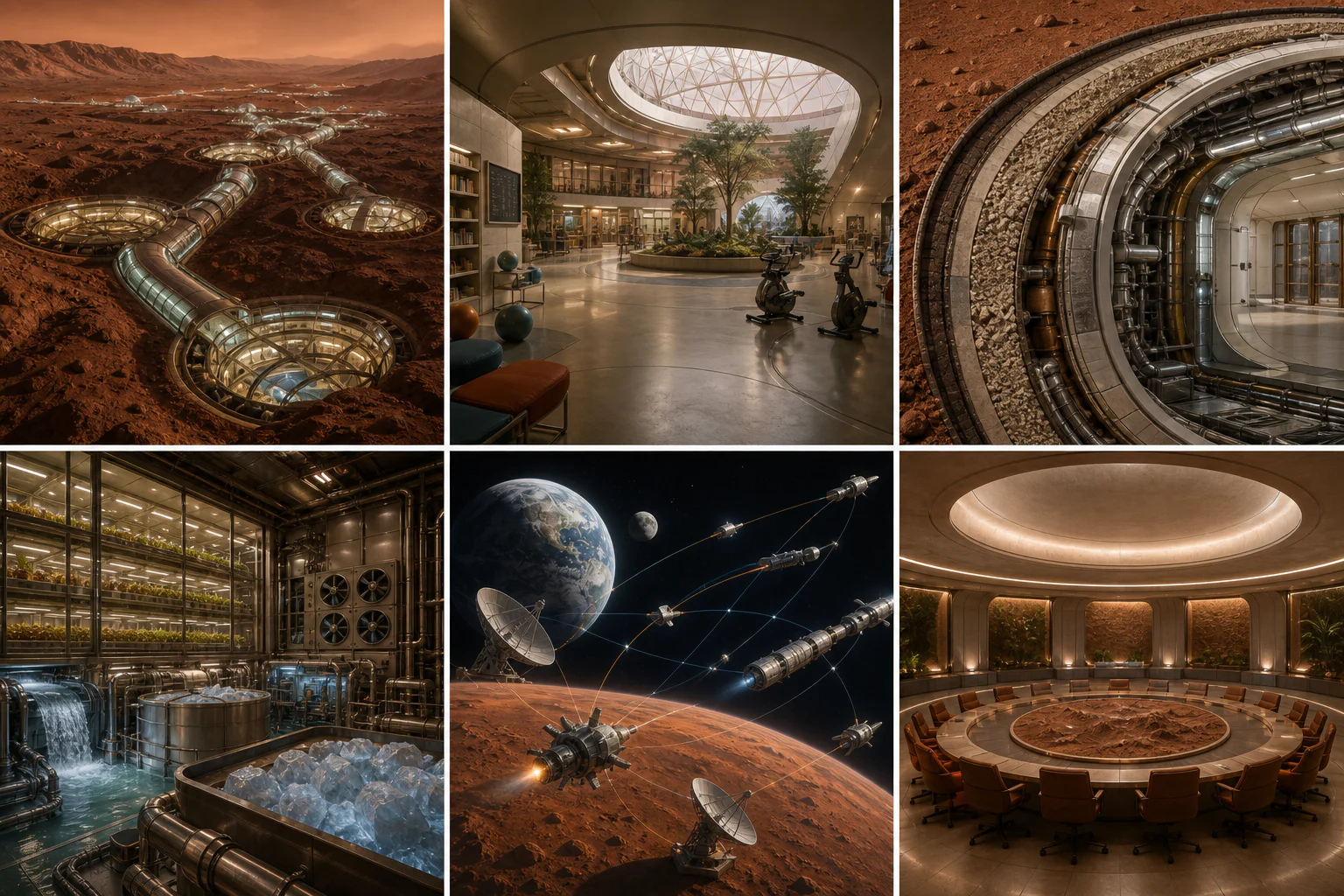
Homes, schools, clinics, workshops and farms occupy separate pressure zones beneath shielding soil. The city is divided from the beginning so that one breach cannot become a settlement-wide failure.
Only landing fields, solar arrays, relays and extraction equipment remain exposed. Long-occupied rooms have finished walls and ceilings; raw Martian soil stays outside the pressure shell.
- RESIDENTS
- 18,600
- PRESSURE DISTRICTS
- 12
- SURFACE GATES
- 4
- PRIMARY TRANSIT
- SUBSURFACE TRAM
02 / ONE SOL
The day is 39 minutes longer.
Life keeps Martian time.
Lighting, school, shifts and sleep follow the sol. Earth time is a second clock used for transport and communication.
Morning light changes slowly to a clear white that helps the body wake. Children learn pressure-door checks on the way to school and train for movement in 0.38G after class. To the Mars-born generation, Earth is a distant gravity well filled with family and history.
Surface work is reorganized around radiation, dust, temperature and link quality. After a shift, people gather in food halls, baths, music rooms and small markets. Survival equipment alone cannot make a life last for years.
- ONE SOL
- 24H 39M
- MARS-BORN
- 1,240
- SCHOOL YEAR
- 180 SOLS
- EARTH TIME
- LOGISTICS CLOCK
03 / HABITAT
Soil stays outside.
The inhabited layer stays repairable.
Shielding, pressure, services and interiors are separate layers, allowing buildings to survive through generations of replacement.
Martian soil moderates radiation and temperature while an independent pressure shell carries the atmosphere. Pipes and power run through accessible service bands, and interior panels can be replaced district by district. Buried does not mean living in a cave.
Corridors and furniture respond to falls, strength training and emergency transport in lower gravity. Surface cameras and light wells bring the changing sky inside where conventional windows are impractical.
- STRUCTURE
- INDEPENDENT SHELL
- SHIELDING
- SOIL + WATER
- SERVICES
- ACCESSIBLE DUAL BAND
- EXPANSION
- STANDARD DOCKING RING
04 / SYSTEMS
Closing loops is not enough.
Ice, air and heat are remade.
Loops reduce losses, local ice and atmosphere replace them, and neighboring districts carry a system that has gone offline.
Water from ice wells moves through drinking, hygiene, agriculture and radiation shielding. The thin carbon-dioxide atmosphere supplies oxygen, fuel and greenhouse carbon. Crops, legumes, fungi and fermentation combine resilience with an actual food culture.
Small reactors carry essential heat and power through nights and dust events. In clear weather, broad solar fields charge storage and make fuel. Redundancy comes before peak efficiency: one failed line must not stop ordinary life.
- WATER
- ICE + HIGH RECOVERY
- AIR
- ATMOSPHERE + ELECTROLYSIS
- POWER
- NUCLEAR HEAT + SOLAR
- FOOD
- PLANTS + FUNGI + FERMENTATION
05 / NETWORK
Resupply does not arrive daily.
The Moon becomes the route's home port.
Major cargo moves on roughly 26-month windows. Lunar shipyards and Martian reserves form one long logistics system.
Marius Arc is more than a supplier of finished goods. Freighters are assembled in lunar orbit, loaded with propellant and shielding, then joined by crews and cargo from Earth. Mars stores critical parts for years, assuming that the next ship may be late.
One-way communication with Earth ranges from four to twenty-two minutes. Medicine, maintenance and government cannot be delegated in real time. Earth is no longer mission control; it is a partner for advice, records and exchange.
- TRANSFER WINDOW
- ABOUT 26 MONTHS
- SIGNAL DELAY
- 4–22 MIN ONE WAY
- PRIMARY HUB
- LUNAR ORBIT SHIPYARD
- CRITICAL RESERVE
- 3 YEARS MINIMUM
06 / COMMONS
Distance demands
a society that can decide here.
Beyond real-time contact, self-government becomes part of life support. Information, authority and responsibility are distributed.
A district cannot wait for Earth during pressure loss or a power shortage. Each council can isolate systems, open reserves and choose evacuation routes. Decision logs are visible to residents and become material for the next drill and redesign.
Birth, long residence, return and contracts with Earth still create unresolved law. Arcadia Commons is not a completed utopia. It aims to be neither a place people cannot leave nor one where they are never allowed to stay.
- GOVERNING UNITS
- 12 DISTRICT COUNCILS
- EMERGENCY POWER
- LOCALLY DISTRIBUTED
- DECISION LOGS
- OPEN TO RESIDENTS
- FOUNDING PRINCIPLE
- RIGHT TO RETURN + REMAIN
SELECTABLE ERAS
Not one frozen future.
A continuing history of settlement.
SPACE:COLONY / 2250