ARCADIA FORWARD / MARS ROUTE / 2220
Reaching Mars is not enough.
The route must keep running.
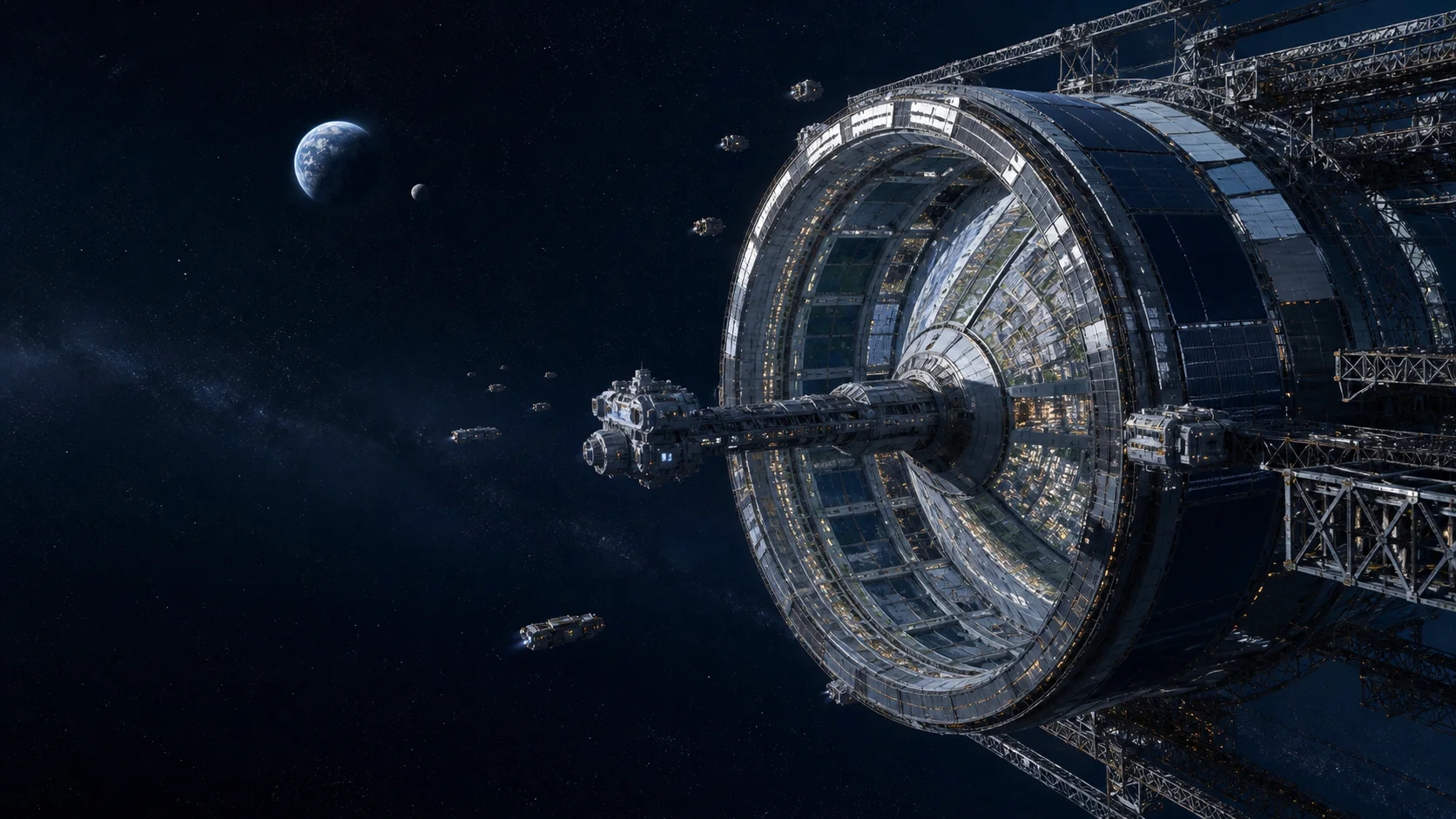
Freighters assembled in lunar orbit depart on every transfer window. With 1,280 residents, the advance habitat is becoming more than an expedition: it must keep life going until the next ship arrives.
ENTER THE ROUTE / 2220 ↓THE ROUTE BEFORE THE CITY
THE ROUTE BEFORE THE CITY
People are not the first cargo.
The conditions for staying go first.
Uncrewed ships arrive before residents with drills, power systems, replacement parts, food and relays. They expand the base before the next crew leaves lunar orbit. The Moon has become the shipyard and warehouse for this long route.
A route exists only when a delayed ship, failed landing, dust event and broken system do not stop construction or ordinary life before the next transfer window.
01 / ROUTE
Not a direct flight from Earth.
Mars ships are assembled in lunar orbit.
Lunar structure and propellant meet terrestrial instruments and crews in one distributed convoy.
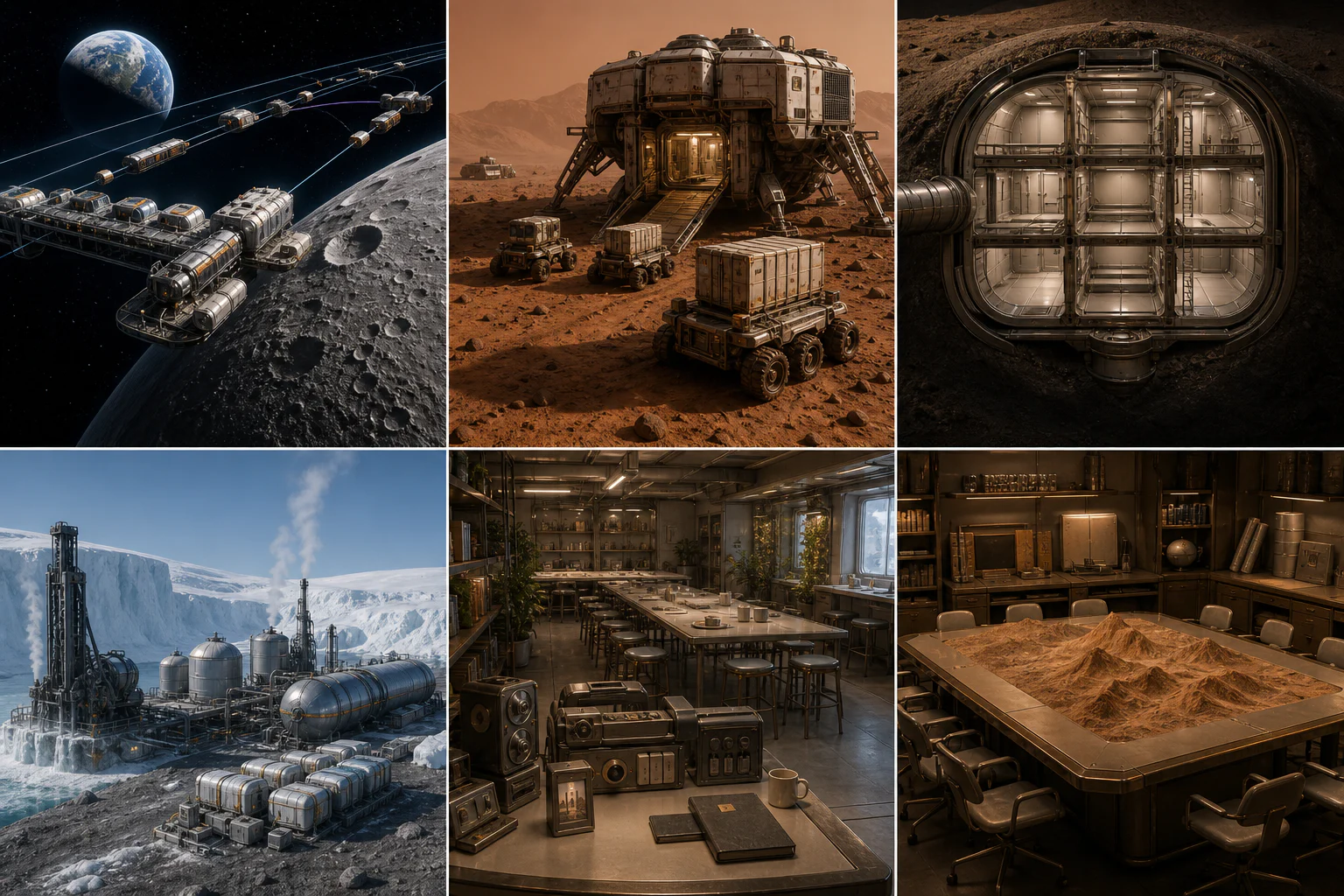
Structure and shielding launched from Marius Arc become freighters in lunar dry docks. Electronics, medical material and crew compartments arrive from Earth and are divided among several ships before departure.
No single vehicle carries the whole mission. Crewed transport, slow cargo and advance relays leave on different paths so that one failure cannot close the route.
- DEPARTURE HUB
- LUNAR DRY DOCK
- MAIN CYCLE
- ABOUT 26 MONTHS
- CONVOY
- CREW · CARGO · RELAY
- PRINCIPLE
- DISTRIBUTED LOADS
02 / CARGO FIRST
Before people arrive,
their next year is already waiting.
Send not only the machines that build a base, but the machines and parts that repair them.
After landing, autonomous rovers divide each payload. Power units move to the field, drills to ice wells and pressure modules to buried districts. Seal tests finish before the crewed ship arrives.
Cargo is measured in days of life and cycles of repair, not mass alone. Duplicate parts travel on separate ships and land in separate zones.
- ADVANCE ARRIVAL
- 180 DAYS
- UNLOADING
- AUTONOMOUS ROVERS
- LANDING ZONES
- 3 DISTRIBUTED
- INVENTORY UNIT
- DAYS + REPAIRS
03 / FORWARD HABITAT
Keep the base divided.
One accident must not stop everyone.
Habitation, medicine, farming, workshops and refuge remain independent pressure zones.
Arcadia Forward is not one large building. Eight pressure districts connect through surface equipment and a subsurface tram. If one closes, another can still support sleep, food and treatment.
Long-stay rooms include personal objects, plants and acoustic choice, not just a desk. Turning an expedition bunk into a home for several years is part of building the route.
- RESIDENTS
- 1,280
- PRESSURE ZONES
- 8
- STANDARD STAY
- 920 DAYS
- REFUGE
- 72 HOURS PER ZONE
04 / LOCAL RESOURCES
The goal is not zero resupply.
It is surviving a late resupply.
Ice, atmosphere, sunlight and nuclear heat replace the heaviest repeated needs first.
Ice wells supply water, oxygen and shielding. Carbon dioxide from the atmosphere supports oxygen and propellant production. Precision components still come from Earth and the Moon.
Nuclear heat supplies the base load while solar fields add power in clear weather. Keeping life support and communication alive after either source fails matters more than peak output.
- WATER
- SHALLOW ICE
- OXYGEN
- ICE + ATMOSPHERE
- BASE POWER
- SMALL REACTORS
- LOCAL OUTPUT
- WATER · OXYGEN · FUEL
05 / CREW LIFE
A link is not a conversation.
It is collaboration while waiting.
Signal delay changes work, medicine and relationships, not just the clock on a message.
Specialists on Earth receive bundled video and diagnostics. While a reply travels, the local team continues its own diagnosis and treatment. Meetings become exchanges of decisions and evidence rather than simultaneous speech.
Families rely on recorded messages more than short calls. In the food hall, residents watch programs that arrived from Earth and discuss events already several days old.
- SIGNAL DELAY
- 4–22 MIN ONE WAY
- HANDOVER
- VIDEO + DECISION LOG
- MEDICINE
- LOCAL FIRST
- DAILY CLOCK
- MARTIAN SOL
06 / HANDOVER
Not just handing over a mission.
Beginning to hand over a place.
The next residents inherit systems, judgment, local conditions and records of failure.
The first crews all planned to return. By 2220, some choose repeated stays, prepare to move as families and take seats on the local operations council.
It is not yet a city. But its purpose has shifted from completing an expedition to sustaining life through the next transfer window. Arcadia Commons begins here.
- GOVERNANCE
- RESIDENT COUNCIL + ROUTE OFFICE
- RECORDS
- OPEN SYSTEM HISTORY
- NEXT EXPANSION
- 12-DISTRICT PLAN
- DESTINATION
- PERMANENT SETTLEMENT
SELECTABLE ERAS
Base, route, settlement,
then an artificial-gravity city.
SPACE:COLONY / 2220